Kerb-Side, After Dark: A Walk Home That Keeps You in Your Body

Photo by Photo by Jakob Cotton on Unsplash on Unsplash
There’s a particular kind of November evening in the UK when the day ends before you do. You leave the office, the shop, the station or the school gate, and the sky is already that deep blue-black. The streetlights are on. The pavements are busy with people walking quickly, heads down, bags tucked in. It’s the walk home in the dark — a journey most of us make so often that it can happen almost entirely without us.
This year, Road Safety Week runs from 16 to 22 November 2026. It’s a good moment to think about how we move through dark streets. But rather than turning this into a lecture about danger, let’s take a different angle: the kerb as a place to pause. Not a dramatic pause. Not a mindfulness exercise that requires a cushion or a quiet room. Just a small, practical moment of embodiment before you step off the pavement.
The walk that happens after the day ends
By mid-November, many of us are walking home in the dark more often than not. The morning commute might have a bit of grey light in it; the evening one rarely does. Add in wet pavements, glare from headlights, a heavy bag and a head full of the day’s loose ends, and it’s easy to arrive home feeling like you were never really there for the journey.
That’s not a personal failing. Attention is finite. When you’re tired, cold and following a familiar route, your brain happily hands the controls to habit. You can walk the same street every evening and barely register the corner shop, the bus stop or the crossing. The body keeps moving; the mind is somewhere else entirely.
The kerb is a useful interruption. It’s a natural threshold — a place where you already have to stop, or at least slow down, before you cross. It asks something of you. And because it happens several times on an average walk, it’s a practice you can repeat without adding anything extra to your day.
A pause that isn’t a lecture
Let’s be clear: this isn’t about turning every street corner into a safety briefing. Road sense matters, of course, but fear-based messaging tends to make us tense rather than present. The point here is simpler. A kerb pause is a chance to let your body catch up with your feet.
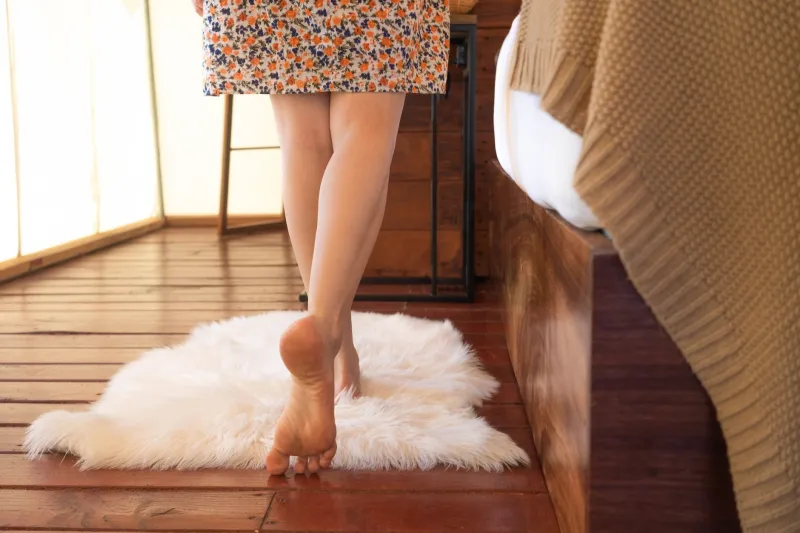
Try it at the next crossing you meet. As you come to the edge of the pavement, let your feet go flat. Notice the sole of your shoe meeting the ground. Feel the weight of your body settling through your heels and the balls of your feet. You might notice the cold coming up through the soles, or the slight give of a paving slab, or the way your bag pulls on one shoulder.
Then take one breath out that’s a little longer than the breath in. Not a big sigh. Just enough to let your shoulders drop a centimetre. Unclench your jaw if it’s clamped. Let your eyes do a proper look — left, right, the road itself — rather than the quick glance you give when you’re already halfway across in your mind.
That’s it. That’s the practice. You don’t need to close your eyes, count to ten or download an app. You’re just using a moment you already have.
Feet first, then the road
There’s a reason to start with the feet. They’re the part of you that’s most in contact with the ground, and they’re constantly sending information to your brain about where you are and what’s happening beneath you. When you’re stressed or distracted, that information tends to get tuned out. Bringing attention back to your soles is a quick way to remind your nervous system that you’re here, on this pavement, in this body.
From there, the breath and the shoulders follow quite naturally. You don’t have to force anything. A slightly longer exhale can help take the edge off the ‘braced’ feeling that builds up when you’ve been rushing. Dropping the shoulders doesn’t solve the day, but it does interrupt the habit of carrying it in your neck.
And then you look. Not because the street is out to get you, but because looking properly is easier when your body isn’t already halfway home. You’re not adding a new rule to your walk. You’re just arriving at the crossing before you cross it.
What about the phone, the headphones and the hood?
Most of us walk home with something occupying our attention. A podcast, a playlist, a message we’re half-reading, a call we’re finishing. None of that is inherently bad. But if you fancy trying the kerb pause, you might find it works better if you give your attention somewhere to land.
That could mean pausing the podcast at the crossing, or slipping your phone into your pocket for those few seconds. It could mean pushing your hood back a little so you can hear the street. It doesn’t have to become a whole new identity. You’re just making a small bit of space.
If you usually wear headphones in both ears, you might try one out at crossings — not because the world is terrifying, but because the pause is more useful when you can hear what’s around you. Think of it as tuning in rather than battening down.
The last stretch home
After you cross, there’s another small moment available: the first few steps on the other side. You can let that be a mini re-set too. Feel the new pavement under your feet. Notice the temperature of the air on your face. Look at the lights in the windows you pass, the glow of a corner shop, the shape of a tree against the sky.
This is the part of the walk that often gets swallowed by anticipation — the key in the door, the dinner, the next task. But the walk home is not just a gap between real life and real life. It’s part of the day. You’re allowed to be there for it.
A small marker for a dark week
Road Safety Week 2026 runs from 16 to 22 November. You don’t need to mark it with a big gesture. You could simply try one kerb pause a day. Maybe on the way to the bus stop. Maybe at the crossing near your front door. Maybe only once, on a evening when you notice you’ve been walking on autopilot.
The aim isn’t to be perfect at it. It’s to remember that you have a body, and that your body is walking you home. The dark evenings will keep coming for a while yet. The kerb will be there too — a small, ordinary place to stop, feel your feet, and step back into yourself before you step into the road.