One Stir, One Breath: A Stir-Up Sunday Practice for the Christmas Kitchen
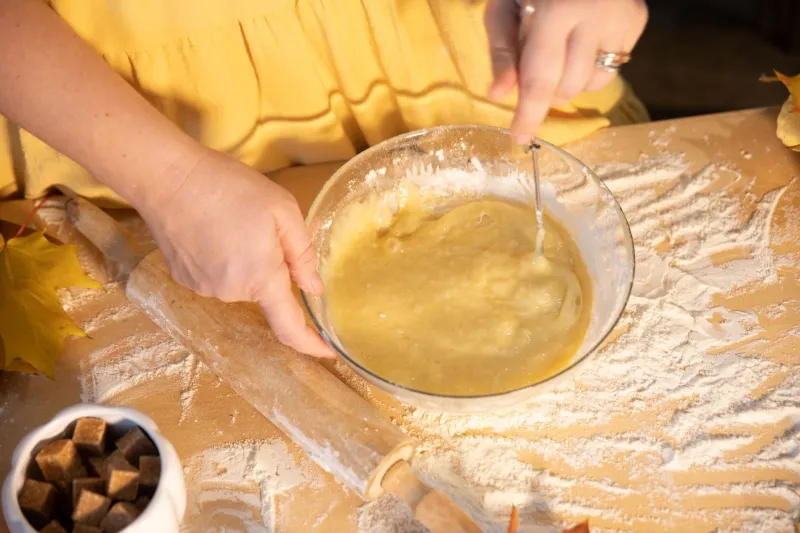
Stir-Up Sunday falls on 22 November 2026 — the last Sunday before Advent, and the traditional day for mixing a Christmas pudding. In many UK homes it is also a day of dried fruit, brandy, crowded worktops and somebody asking where the good spoon has gone. This year, rather than treating the pudding as one more item on the festive list, you could use it as a small embodiment practice: five minutes of noticing your feet, your hands, the weight of the spoon and the smell of spice.
You do not need a family recipe, a pudding basin or a strong opinion about suet. You do not need to believe that stirring clockwise brings luck. The point is simpler: a familiar seasonal action can bring you back into the room you are actually in.
A ritual already has a shape
One of the reasons Stir-Up Sunday works as an anchor is that it comes with a shape. There is a bowl, a spoon, a list of ingredients and a known sequence. You are not inventing a wellness routine from scratch. You are stepping into something that already exists.
That is useful for busy brains. When the Christmas build-up starts to feel like a group chat with tinsel, a task with clear edges can be calming. The pudding does not ask you to be festive on demand. It asks you to stand still, stir, and wait.
Begin with the floor, not the recipe
Before you reach for the dried fruit, pause at the counter. Feel the floor under your feet — through socks, slippers or bare skin. Let your weight settle. Notice whether you are leaning into one hip, gripping the worktop, or holding your shoulders somewhere near your ears.
Take one ordinary breath. Not a big wellness breath. Just enough to remind yourself that you are a person in a kitchen, not a machine completing a task.
If you are sharing the kitchen, this might be the only quiet moment you get. Take it anyway.
The stir itself: weight, resistance, scent
Hold the wooden spoon and notice its weight. Is it heavier than you expected? Does the handle sit comfortably in your hand? When you push it through the mixture, feel the resistance. Christmas pudding is not a smooth, polite substance. It is dense and sticky and full of texture. Let your hand and wrist register that.
Listen to the sound of the spoon against the bowl. Notice the smell of mixed spice, citrus peel or brandy as it rises. If memories arrive — a grandparent's kitchen, a childhood year, a person who is no longer here — let them come and go without turning the pudding into a therapy session.
Stir a few times slowly. Then one more time, a bit more deliberately. That is enough.
Five minutes, roughly
If you want a loose structure, try this:
- Stand with both feet flat and feel the floor.
- Hold the spoon for a moment before you use it.
- Stir slowly for three or four turns, noticing weight and resistance.
- Pause and smell the mixture.
- Take one breath before you carry on.
That is the whole practice. It fits between preheating the oven and finding the pudding basin. It does not require a cushion, an app or a quiet room. It works with the radio on and someone asking whether we have enough custard.
When the pudding is already made
Shop-bought pudding is not a failure of tradition. If your pudding is already in the cupboard, you can still use the day. Stir a jar of mincemeat. Make a bowl of custard. Open the spice jar and smell it. Or simply stand at the kettle and feel your feet while it boils.
The ritual is not really about the pudding. It is about letting an ordinary action have your attention for a few minutes.
Shared kitchens and complicated feelings
Christmas kitchens are not always calm. They can be crowded, hot and full of unspoken family weather. If someone else is banging cupboard doors, you do not have to turn the stirring into a performance of serenity. You can take one turn, notice your feet, and step away.
If the day brings grief, tension or complicated family feelings, let the practice be small. You are not trying to fix Christmas. You are giving your body a reference point: the floor, the spoon, the breath, the smell of spice.
After the spoon goes down
When you have finished, put the spoon down and feel your hands. Wipe them on a tea towel. Notice the kitchen around you — the steam, the surfaces, the sound of the radio. Take one last breath before you move on to the next thing.
The pudding will steam for hours. You do not have to. A few minutes of presence in the Christmas kitchen is enough.