The Corridor Before the Crowd: Three Discreet Anchors for the Work Christmas Do
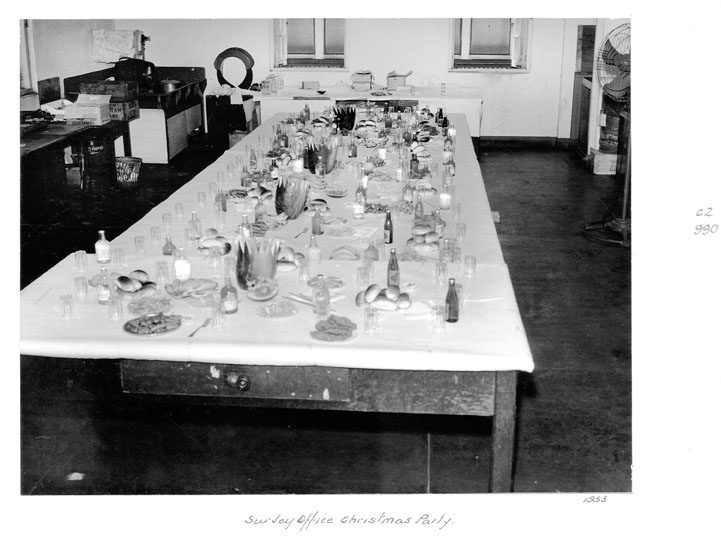
Photo: Lands Department, Survey Office, Cartographic Branch, Photographic Section, Public domain, via Wikimedia Commons
The invite said festive drinks and nibbles. The corridor says something else. It is 6.12pm, the office lights are still on, and you can hear a playlist doing its best from the function room above the pub. You are holding a coat, possibly a Secret Santa gift, and the version of yourself that is good at small talk has not arrived yet.
This is the threshold: the bit between the corridor and the crowded room. It can feel longer than it looks. Some people breeze through it. Others find that festive socialising is more draining than merry, and that the effort of appearing relaxed is a workout in itself. Neither is a character flaw.
The Corridor Is Part of the Event
We tend to treat the corridor as a waiting area before the real thing. In body terms, it is not. It is where your nervous system starts making predictions: who will be there, how loud it will be, whether you will get stuck in a conversation about the Christmas rota. Those predictions can tighten your shoulders before you have even seen a paper hat.
You do not have to psych yourself up with a pep talk. You can give your body something concrete instead.
Anchor One: Feet on the Carpet
Before you reach the door, stop for a second. Feel both feet on the carpet, or on the lino, or on the pub floor if you are already inside. Notice the heel, the ball of the foot, the place where your weight is actually resting. Shift slightly from one foot to the other.
This is not grounding in a mystical sense. It is giving your brain a reliable map at a moment when the social map feels uncertain. No one can see you doing it. You are just a person standing in a corridor, which is a perfectly normal thing to be.
Anchor Two: Weight in the Chair
Once you are in the room, find a chair. Not because you have to sit down for the whole evening, but because chairs are useful. Perch on the edge of one, or lean against the back of a bench, and let your weight be received for twenty seconds.
Many of us hover half-standing at these events, ready to leave, ready to get another drink, ready to look busy. The chair gives you a different option. You are allowed to occupy space. You are allowed to sit down at your own Christmas do.
If there is no chair free, use the back of a bench, a windowsill, or the solid bit of wall by the coat pile. The principle is the same: let something take your weight.
Anchor Three: One Slow Exhale at the Door
The last anchor is the one you use at the threshold itself. Before you walk in, let one exhale be longer than your inhale. Not a dramatic sigh. Just a quiet breath out through the nose, as if you are mildly bored rather than braced.
A longer exhale is one of the simplest ways to nudge your nervous system away from alarm mode. It will not make you love small talk. It will not make the music quieter. But it can take the edge off the moment before you step through.
Then step through. You do not have to arrive as the loudest person in the room. You just have to arrive.
When the Room Is Loud
If you are twenty minutes in and your jaw is set, use the same anchors again. Feet on the floor. Weight in the chair. One slow exhale. You can also go to the loo, stand by a window, or take a moment in the corridor you just came from. Leaving the room for two minutes is not failure. It is maintenance.
And if you need to leave early, leave early. The point of these anchors is not to make you stay longer. It is to help you stay with yourself while you are there.
Leaving Is Also a Body Practice
At the end of the night, collect your coat and feel your feet again. Say the goodbyes you want to say. Step out into the cold air and let one more long exhale go. The Christmas do is over. Your body is still here.
That is the whole practice: three quiet anchors, used before, during, and after the crowd. Not a cure for social anxiety, not a personality transplant. Just a way to walk into the room without leaving yourself in the corridor.