The Cool-Air Threshold: A Sunday Pause Before Monday
Sunday evening has a particular texture in the UK. The good mug is in the sink, the light has gone early, and somewhere between the leftovers and the Monday calendar the body starts to brace. It can show up as restless shoulders, a jaw that has quietly clamped, or a vague urge to stand in front of the fridge and look for something that isn’t hunger.
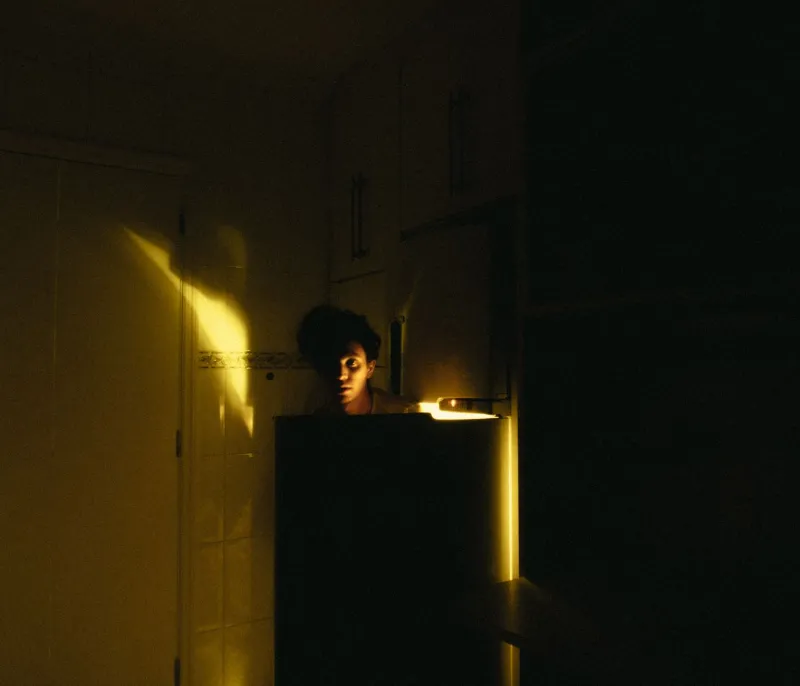
That last one is worth noticing. Not because it is a problem to solve, but because it is a very ordinary signal. The fridge door is a threshold we cross dozens of times without thinking. On a Sunday night, it can become a useful place to pause.
Why Sunday evening lands in the body
The weekend-to-week transition is not just a mental shift. It is a change of pace, noise, responsibility and anticipation. Even a week you are looking forward to can bring a low hum of preparation: the school uniform, the commute, the meeting you would rather not chair, the bins that need putting out.
Research on rituals and transition suggests that small, repeated actions can help people mark a boundary between one mode and another. The point is not magic. It is predictability. A familiar cue — a specific spot, a repeated movement, a change in temperature — can give the nervous system something steady to land on while the mind catches up.
Slow breathing is often described as calming, and there is reasonable evidence that extending the exhale can support a shift towards the parasympathetic side of things. It is not a cure for a difficult job or a packed week. It is a small, accessible way to stop adding extra bracing to an already full load.
The fridge door as a threshold, not a snack
Most mindfulness advice asks you to find a quiet corner. That is lovely if you have one. Many of us do not. The fridge door, by contrast, is already there. It is lit, cool, tactile and slightly boring — which makes it surprisingly good as an anchor.
The invitation is not to eat. It is to notice the change in temperature as the door opens, the sound of the motor, the feel of the handle, the ordinary domestic theatre of it. You are using the fridge as a threshold object: a place where the weekend can end and the week can begin without a speech.
This is not about creating a perfect Sunday routine. It is about giving the body one clear, repeatable moment that says: we are changing gear now.
A one-minute practice
Try this once on a Sunday evening, ideally before you start the final round of prep. It takes about a minute.
- Stand at the fridge. Let your feet feel the floor. You do not need to straighten up or arrange yourself. Just arrive.
- Rest your hand on the handle. Notice the temperature of the metal or plastic. Notice whether your grip is tight or light.
- Open the door. Let the cool air reach your face and hands. Pause for one natural breath. Look at what is there without deciding anything.
- Take three unhurried exhales. Let the out-breath be slightly longer than the in-breath, but not strained. On each exhale, let your shoulders drop a fraction. No counting beyond three.
- Close the door. Feel the seal, the click, the small change in sound. Stand still for one more breath.
- Name the transition silently. Something plain is enough: “Weekend’s done. Week’s starting.” Then carry on with the evening.
That is it. No cushion, no app, no perfect routine. If you forget, the fridge will be there tomorrow.
What it is and isn’t
This practice is not a replacement for proper rest, boundaries or practical help. If Sunday evenings are consistently difficult — if you feel dread that lingers, sleep is affected, or the week feels unmanageable — it is worth talking to your GP or a trusted professional. A fridge-door pause is a small support, not a solution to every pressure.
It is also not about forcing yourself to feel calm. You might open the door and notice irritation, tiredness or nothing at all. That is still useful information. The aim is simply to stop the transition happening entirely on autopilot.
Making it fit a real British Sunday
Your Sunday may involve a roast, a laundry pile, a long drive back from family, or a quiet flat and a boxset. The practice can fit around any of it. Do it while the kettle boils. Do it after you have written the week’s lunches on the back of an envelope. Do it in the ad break.
The cool air is the cue. The three exhales are the punctuation. The closed door is the full stop.
Monday will still arrive. But you do not have to meet it with your shoulders already up by 8pm on Sunday. One minute at the fridge door is a small, ordinary way of saying: I am here, and I am changing gear.